Jennifer Morrice’s stage 3 lung cancer diagnosis came as a total shock. The 35-year-old had never smoked and was flabbergasted at hearing the news. Her doctor at the time gave her two years to live, a fate the San Francisco wife and mother said was unacceptable. “I laughed out loud and walked out. I needed a medical team who understood that dying wasn’t an option,” Morrice said.
Morrice found her way to Sutter Pacific Medical Foundation cardiothoracic surgeon Dr. Peter Anastassiou, who removed her lower left lung, a surgical procedure known as a lung resection or lobectomy. She also underwent radiation and chemotherapy.
For 10 years, Morrice’s cancer remained in remission, but a screening last year detected a suspicious spot in the mediastinum, the area between the lungs. Because lung cancer is one of the most aggressive types of cancer — taking as little as three to six months to double in size — Morrice wasted no time in connecting with her Sutter care team for swift diagnosis. Since her first bout with the disease, she was encouraged to learn that a faster and less invasive tool for diagnosis was now available.
At Northern California’s Sutter Health, more of the integrated health system’s pulmonary care teams are using the latest robotic-assisted technology to diagnose lung cancer and determine how far it has spread, known as staging, without the need for intensive surgery. Without this essential diagnostic information, doctors cannot move forward with next steps.
“You have to move quickly [with lung cancer], so it’s important to know what stage the cancer’s in so your team can implement a plan of attack,” explains Morrice.
Innovative Diagnostic Tool
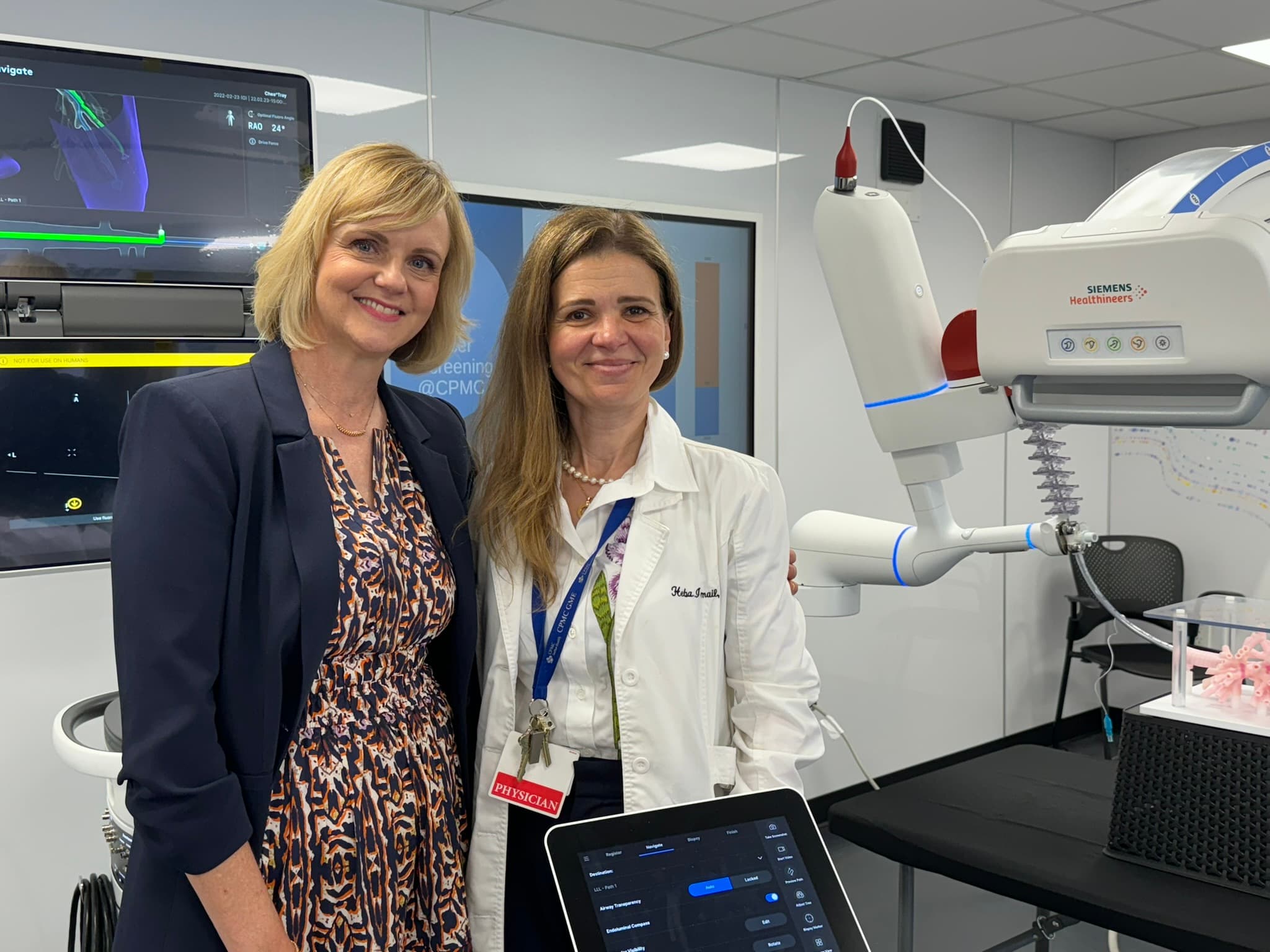
Dr. Heba Ismail, an interventional pulmonologist at Sutter’s CPMC in San Francisco, a leader in lung cancer care, investigated Morrice’s lung nodule using robotic-assisted bronchoscopy. This diagnostic advancement relies on the Ion robot, allowing doctors to diagnose and stage, even treat, lung cancer in one procedure, which, according to Dr. Ismail, reduces stress for patients and speeds the time between diagnosis and staging to treatment.
During the procedure, Dr. Ismail uses the robot’s external controller to navigate a catheter, or thin tube, equipped with a light and tiny camera, through a patient’s mouth to the suspicious lung lesion. Next, the catheter is locked in place before the surgeon passes a special biopsy needle through it to collect tissue from the nodule. The tissue is then analyzed by a pathologist to determine if it is cancerous or not.
“Jennifer’s airways had a lot of scar tissue from previous treatments and her nodule was very close to the heart, making the procedure very delicate,” said Dr. Ismail. “The robotic technology allows me to locate and biopsy suspicious tissue with incredible dexterity and precision.”
Dr. Ismail adds, “Having this advanced capability was not available to patients a few years ago and should be viewed as the gold standard in how we diagnose and help treat people with lung cancer.”
Research shows that early diagnosis and intervention are critical to improving short- and long-term health outcomes for patients with lung cancer.
Overcoming ‘Stage’ Fright
Today, Morrice uses tyrosine kinase inhibitor, or TKI, an oral, targeted therapy, to suppress her recurrent lung cancer. She’s also a lung cancer ambassador with the American Lung Association-San Francisco chapter. For nearly a decade, Morrice has participated in awareness events to draw attention to the prevalence of lung cancer, especially calling attention to the increasing number of young, nonsmoking women diagnosed with the disease.
“I want to take the scariness out of cancer diagnosis, especially for people diagnosed in later stages, and encourage early screening and vigilance. I was a woman who didn’t fit the criteria for lung cancer, and to be smacked in the face with a stage 3 lung cancer diagnosis was surreal. The biggest fear is the fear of the unknown and when you have the right team around you and the necessary information to move forward, well, there’s empowerment in that knowledge. I’m grateful some good progress has been made [in diagnostics] with this technology, and if sharing my story can help others in that way, then that’s meaningful and what matters to me.”