Understanding Your Newborn’s Senses
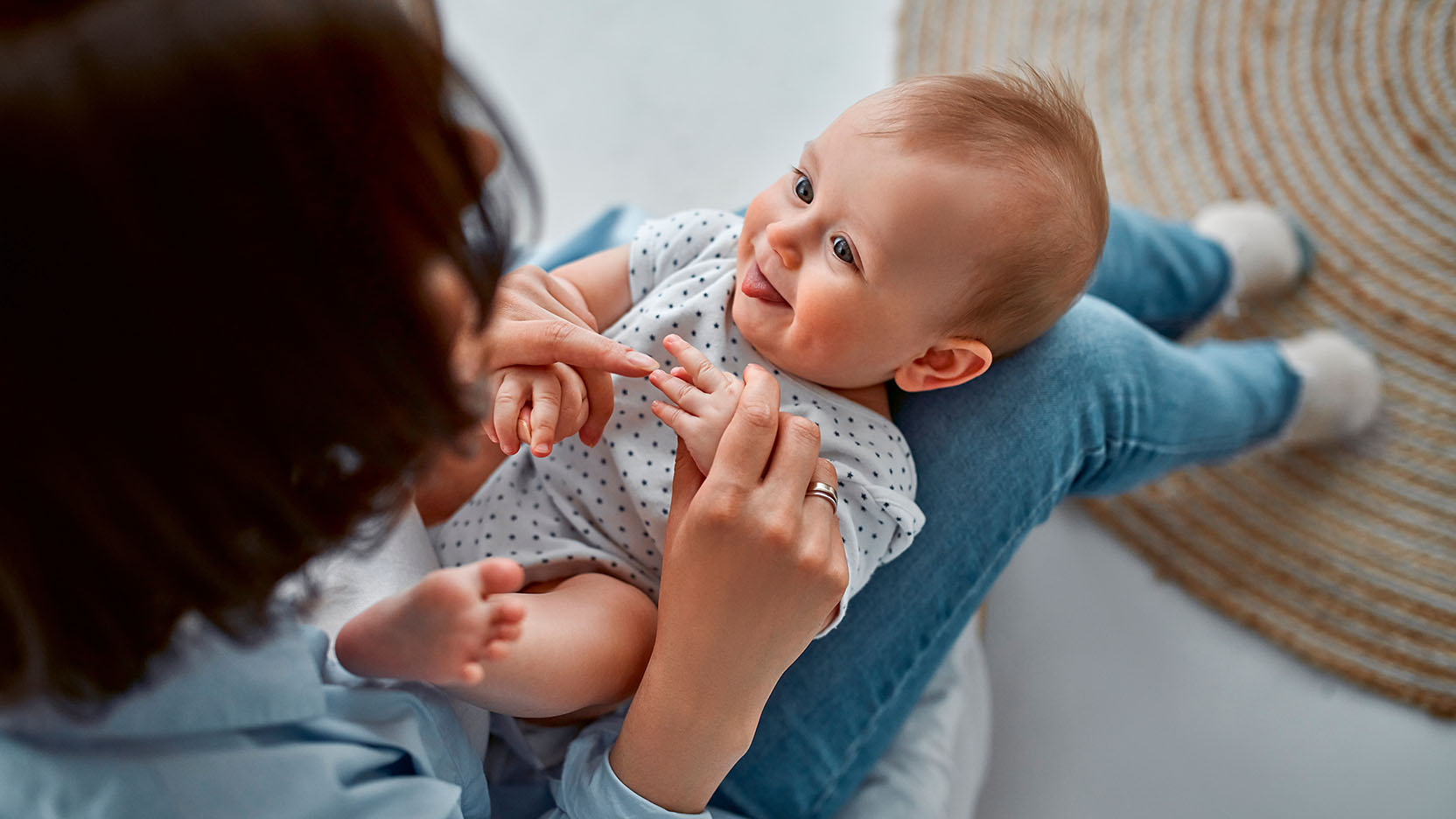
From the moment they’re born, babies can see, hear, smell, taste and touch. These senses help them connect with and respond to their new world. Just as babies develop physically and mentally, they also go through sensory newborn development stages.
Babies react differently to sensory stimuli. Some newborns are sensitive and may become easily agitated by loud noises, rough textures or bright lights. Other babies don’t notice these sensory inputs as much. From what to expect from your newborn’s visual development to why a newborn hearing screening is important, let’s walk through the newborn development stages for the five senses.
Stages of Newborn Hearing Development
Birth to 3 months: A baby’s hearing is well developed, even in the uterus, as is shown by the startle, or Moro, reflex in response to loud noises. Babies can make out both of their parents’ voices right after birth. However, babies pay more attention to high-pitched voices, as they hear best in the higher ranges. Your baby will have a newborn hearing screening before you leave the hospital after birth. A newborn hearing screening is a painless test that takes less than 10 minutes and can even be done when your baby is asleep.
“If your baby does not pass the initial hearing screen, the test is usually repeated once more while your baby is in the hospital. If baby still does not pass, follow-up testing is arranged after discharge and many babies do pass at that time,” says Catherine Pourdavoud, M.D., a pediatrician with Sutter.
If you have questions about your newborn’s ability to hear, contact your baby’s pediatrician.
Tip: Coo, talk to your baby, read books, play with squeaky toys, sing and play music.
2 months: Your baby may start to coo. “Coos are usually soft vowel sounds, like ‘oo’ and ‘ahh,’ and are often your baby’s first attempts at communication,” says Pourdavoud.
Tip: Talk face-to-face, imitate your baby’s sounds, narrate your day and use exaggerated expressions and tone.
4 to 6 months: Your baby may start to imitate the sounds they hear. They’ll probably start to babble, with repeated sounds like “ba,” “da,” and “ma” as your baby experiments with their voice.
Tip: As you walk around, talk to your baby. Point out objects, explain what you’re doing. Continue reading and singing together.
6 to 9 months: Your baby is starting to recognize words and familiar voices. They’ll also start to pick up on where sounds come from.
Tip: Keep talking, and let your baby mimic the sounds you’re making. Continue to play music.
9 to 12 months: Your baby will understand many familiar words. By 12 months of age, most babies are also able to say around three simple words, such as “mama” or “dada.”
Tip: Take turns talking, playing and singing.
Newborn Visual Development
Birth to 3 months: Your baby may be fascinated by dramatic contrasts, such as black and white shapes, but will be most responsive to your face. A baby’s ability to focus at birth is about the same distance as from a baby at the breast to a mother’s face (8 to 12 inches).
3 to 6 months: Starting around 3 to 4 months, babies can start to focus on objects that are 3 to 6 feet away as well as seeing more colors.
Tip: Carry your baby around so that they can see their surroundings.
6 to 9 months: At this stage, your newborn’s visual development will make an important step forward — being able to focus whether things are close or far away.
Tip: Use toys of various shapes and colors, and play peek-a-boo.
9 to 12 months: Depth perception should improve.
Tip: Continue to point out objects and play peek-a-boo.
The Development of Taste and Smell
Birth to 3 months: There’s evidence that a newborn has the ability to respond to sweet, salty, sour and bitter tastes, as well as to a variety of smells. Newborn babies can distinguish their mother’s clothing from others using only their sense of smell.
4 to 6 months: Your baby may be more interested in how foods smell and may start to take an interest in new foods and flavors.
Tip: When your baby shows signs of readiness — often around 4 to 6 months — start to offer purees and select solid foods. For exclusively breastfed infants, many pediatricians generally recommend waiting until 6 months for solid food introduction. “This timeline may be different for some babies including premature infants, so be sure to discuss with your pediatrician,” Pourdavoud says.
6 to 9 months: Your baby may be more likely to reach for food and start to refuse things that smell bad.
Tip: Introduce new foods slowly. Watch for reactions, especially to textures. Talk to your pediatrician about the top allergen foods (such as peanut butter and egg) and introducing them to your baby before they turn 1.
9 to 12 months: You might find that your baby is even more choosy about smells.
Tip: Continue to introduce new flavors as well as different food textures.
A final tip: Be patient. “Sometimes it can take seven or more exposures to a new food before a baby accepts it or likes it, so don’t give up and try to make it fun,” Pourdavoud says.
How Sense of Touch Develops
Birth to 3 months: Touch is your baby’s first sensation. Most of your early contacts will involve touch as you cuddle, rock and caress your new baby. During feeding, whether by breast or bottle, is an ideal time for you to give your baby this very important, close physical contact.
Tip: Consider giving your newborn a daily gentle massage.
3 to 6 months: You may notice that your baby uses their hands and mouth to better understand objects. Your baby may begin to intentionally reach for and grasp an object. They can hold on to larger items such as rattles.
Tip: Let your baby experience different textures through toys and blankets, and observe their reactions.
6 to 9 months: Babies continue to explore objects. They refine their skills by transferring objects between their hands and exploring them more purposely. They may start developing more precise finger movements.
Tip: Try to add textures to your baby’s day. That can be through clothing, toys, food and more.
9 to 12 months: Babies develop a pincer grasp (using the thumb and index finger together) allowing them to pick up small objects and feed themselves. Exploration of objects is more detailed and coordinated.
Tip: Let your baby explore different types of objects and textures. Let them feed themselves with soft finger foods. Start to play pat-a-cake. Continue to practice fine motor skills.
Explore related topics
Trusted Pediatricians at Sutter Health
For help at every age and stage, make sure you have a pediatrician you trust.
Meet our care team